


Amsterdam’s Red Light District is one of the city’s most famous areas and, at the same time, one of the most discussed attractions in the Netherlands. It is often seen only as a nightlife area, but in reality it is an old part of Amsterdam with a rich history, canals, narrow streets, historic buildings and a distinctive urban atmosphere.
The district is interesting not only because of its reputation. It also shows how Amsterdam has changed: from a medieval port city into a modern European capital, where historical heritage exists side by side with tourism, regulation and everyday city life.
1. What is the Red Light District?
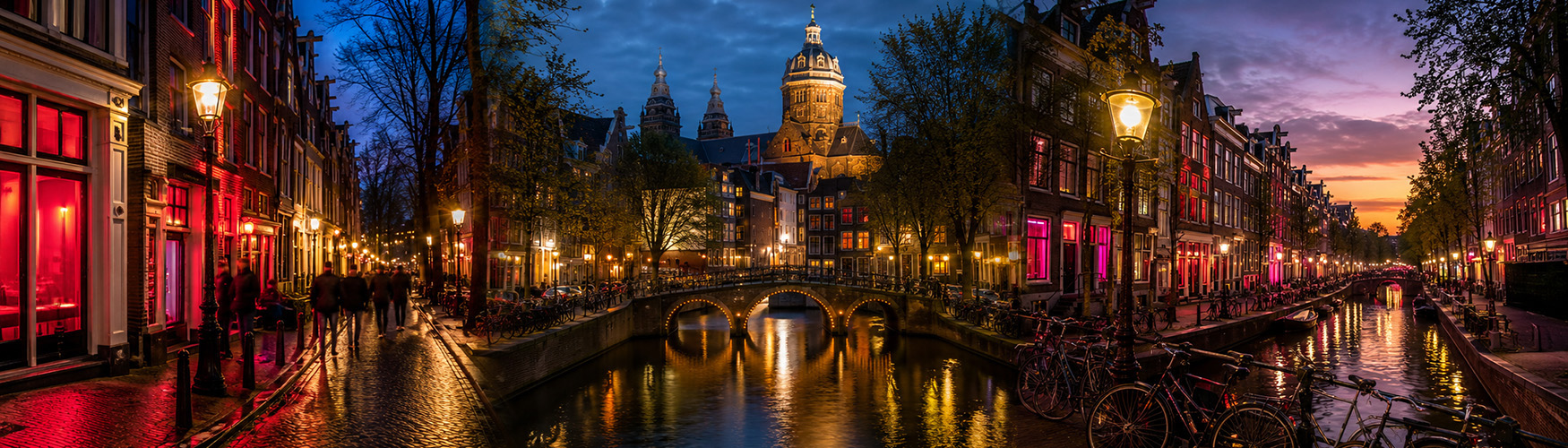
The Red Light District is a historic area in the centre of Amsterdam, known for the legal service industry associated with representatives of the world’s oldest profession. Its main visual feature is the red-lit windows, which gave rise to the name Amsterdam’s Red Light District.
Officially, in Dutch, this part of the city is called De Wallen. It is a real urban neighbourhood, where residential houses, cafés, canals, museums, churches, hotels and old streets are located next to each other.
It is important to understand that the Red Light District is far from being only about nightlife. It is part of old Amsterdam, where you can see architecture from different periods and feel the atmosphere of a city shaped by trade, the sea and a long tradition of urban freedom.
2. In which part of Amsterdam is this district located?
The Red Light District is located in the historic centre of Amsterdam. It is close to Dam Square, Amsterdam Central Station and the city’s oldest church, Oude Kerk.
Thanks to this location, the area is easy to include in a walking route through the city centre. Many tourists pass through De Wallen while exploring the old town, even if they do not plan to visit any nightlife venues separately.
Nearby you will find canals, small bridges, narrow alleys, old houses and popular tourist streets. That is why the district is often perceived as part of a general walk through historic Amsterdam.
3. How and when did this district appear?
The origins of this district go back to the Middle Ages. From around the 14th century, Amsterdam was actively developing as a trading and port city. Merchants, sailors, craftsmen and travellers passed through the city, while a lively urban environment gradually formed near the harbour.
Where sailors and visitors stayed, taverns, inns, places of rest and entertainment began to appear. Over time, this part of the city became associated with nightlife and services aimed at temporary visitors to Amsterdam.
The city’s port past played an important role in shaping the district’s reputation. Sailors arriving after long voyages were looking for accommodation, food, drinks and entertainment. Around these needs, a particular kind of urban infrastructure gradually emerged.
4. Why is the district associated with red lights?
The name “Red Light District” is connected with the red lighting of the windows. Red light became a recognisable symbol of the area and a way to indicate premises where specific services for men were provided.
This visual image did not appear all at once. The modern appearance of the district developed gradually, especially in the 20th century, when the industry became more open and more visible to tourists.
The red-lit windows became a distinctive sign of the district. Thanks to them, De Wallen became easily recognisable and gained worldwide fame as one of Europe’s most unusual tourist areas.
5. Historical development of the district by period
The Middle Ages
In the Middle Ages, the district developed as part of the port city. Its proximity to the water, trade routes and the urban harbour made it a convenient place for commerce, accommodation for visitors and the operation of numerous establishments.
16th–18th centuries
During the active development of maritime trade, Amsterdam became one of the most important cities in Europe. The flow of sailors, merchants and foreign guests strengthened the role of the central districts as places of communication, trade and entertainment.
19th century
In the 19th century, the authorities began to control urban life more actively, including the sphere of public entertainment. The world’s oldest profession continued to exist, but attitudes toward it changed depending on the political, religious and social situation.
20th century
In the 20th century, the district became more visible to tourists. Gradually, the image of the Red Light District that is known around the world today took shape: windows, red lighting, narrow streets, nightlife and a constant flow of visitors.
21st century
In the 21st century, the district continues to change. The city authorities are working to reduce excessive tourism, improve safety, protect the rights of workers and keep the historic centre liveable for local residents.
6. What is the Red Light District known for today?
Today, the Red Light District is one of the most visited parts of Amsterdam. Tourists come here out of curiosity, to walk through the old centre, to discover an unusual cultural side of the city or to visit museums and historic sites.
The district is known for several features:
- red-lit windows;
- old canals and bridges;
- narrow medieval streets;
- large numbers of tourists;
- a combination of nightlife and historic architecture;
- proximity to important attractions in the city centre.
At the same time, De Wallen remains more than just a tourist destination. People live here, and shops, cafés, hotels and various institutions operate in the area. For this reason, the city is constantly looking for a balance between tourist interest and normal neighbourhood life.
7. Rules of behaviour for tourists
The Red Light District requires respectful behaviour. Despite its popularity with tourists, it is not a place for careless entertainment or for crossing personal boundaries.
The basic rules are simple:
- do not photograph the windows or the people working in them;
- do not disturb local residents;
- do not make noise near residential buildings;
- maintain public order;
- keep an eye on your belongings in crowded areas;
- do not treat the district as an attraction without rules.
It is especially important to remember that behind the tourist image of the district there are real people and a real working environment. Respectful behaviour is an essential part of visiting De Wallen.
8. Who might find the Red Light District interesting?
This district may be interesting for different types of travellers. It is suitable for those who want to see one of the most famous parts of Amsterdam and understand why the city has gained a reputation as a free-spirited and unusual European capital.
The area will also appeal to lovers of history, architecture and old urban neighbourhoods. Even without visiting nightlife venues, it is possible to see an important part of the historic centre here.
In addition, De Wallen attracts those who are interested in urban culture, social rules and how controversial areas of public life are regulated in different countries.
9. When is the best time to visit the district?
During the day, the district looks calmer. This is a good time to look at the architecture, canals, Oude Kerk and the old streets. A daytime walk is suitable for those interested in history and for visitors who want to see the area without the evening crowds.
In the evening, the district becomes livelier. The lights come on, more venues open and the flow of tourists increases. It is in the evening that you can see the image of the district most often shown in guidebooks.
At the same time, late in the evening and at night the area can become very crowded. If you prefer a calmer walk, it is better to choose the early evening or daytime.
10. To sum up
Amsterdam’s Red Light District did not appear as a specially created tourist zone, but as part of the old port city. Its history is connected with trade, seafaring, the arrival of visitors and the gradual formation of urban nightlife.
Over time, the district gained worldwide fame thanks to its red-lit windows, the liberal approach of the Netherlands and the unusual combination of historic architecture with an open urban culture.
Today, De Wallen is not only a symbol of nightlife, but also an important part of Amsterdam’s historic centre. Here, the past, tourism, local life, legal regulation and modern urban change are closely intertwined. That is why the Red Light District should be viewed not only as a famous attraction, but also as an area with deep historical context!
